
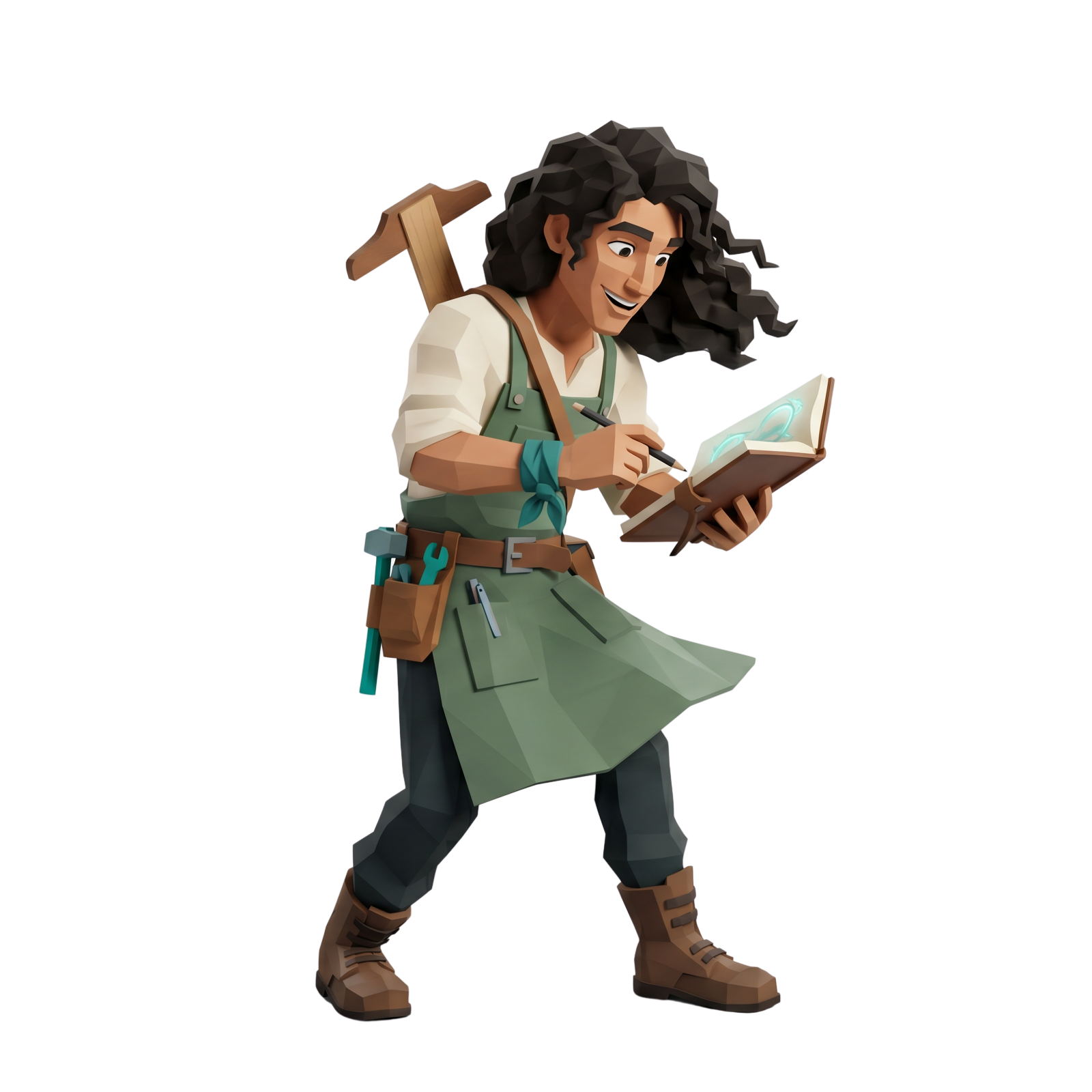
The Apprentice
You learn best by doing it together.
“I learn more from the second question than the first answer.”
The Apprentice figured out the right way to use AI before most people with far more experience: treat it as a conversation, not a command. That instinct is right, and it's compounding into real skill faster than they realise.
Does this sound like you?
Your AI conversations feel more like a dialogue than a query
You've found yourself saying 'thank you' to ChatGPT before catching yourself
You find AI most useful when you build on the response rather than just take the first output
You're more comfortable in a back-and-forth than reading documentation
Research note: Collaborative learning style maps to social constructivism (Vygotsky), specifically learning through dialogue and co-construction. Research shows this style produces deeper understanding and higher retention in AI-assisted tasks.
§ 01
Who is the The Apprentice?
The Apprentice is a Level 2 user who stumbled into the correct method almost immediately: they talk to AI. Not at it. This is rarer than it sounds. Most early users treat AI like a search engine, one question, one answer, move on. The Apprentice iterates, follows up, pushes back, and builds on responses. The outputs are noticeably better for it.
Their challenge now is consistency. The conversational instinct is there; the habit of applying it to every relevant task isn't yet. The Apprentice who learns to reach for AI the way they'd reach for a trusted colleague, reliably, not just occasionally, begins to compound quickly.
Style philosophy · Collaborator
“You work with AI the way good collaboration is supposed to work: building on each other's thinking, refining through dialogue. Most people treat AI as a vending machine. You figured out the right way almost immediately.”
§ 02 — AI fingerprint
AI fingerprint
Full report →How this persona maps across six dimensions of AI use.
Depth
2/10
Analysis
2/10
Creation
3/10
Speed
3/10
Automation
1/10
Breadth
3/10
Strengths
- 01
Dialogue-native
Builds on AI responses rather than accepting them, which produces outputs that improve with every message.
- 02
Learns through conversation
Uses AI sessions as genuine learning experiences, not just task-completion exercises.
- 03
Low iteration friction
Comfortable refining and redirecting mid-session in ways that users with a command-and-accept mindset never develop.
- 04
Explains their process
Can describe how they work with AI in a way that actually helps others, because the method is natural to them.
Friction points
- 01
Inconsistent use
The instinct is there; the habit isn't yet. There are tasks that should involve AI that still don't.
- 02
Long sessions, low output
The conversational mode can extend sessions without always producing more. Knowing when to stop and ship is a skill.
- 03
Hasn't systematised the best prompts
Great conversations happen, but they're not being captured into reusable templates that would compound the value.
§ 03 — A day with AI
How the The Apprentice actually spends a day.
A composite day drawn from the patterns we see in this persona. Light on prompts; heavy on thinking.
Opens a conversation, not a prompt
Not 'write me a summary.' 'Here's the situation, help me think through how to frame this.' The output is better. Always.
Hits a problem mid-task
Describes the problem to Claude the way they'd describe it to a smart friend. Three messages in, they have a direction. The problem didn't need solving. It needed articulating.
Explains to a colleague how they work
"It's just a conversation." The colleague is surprised. Most people never figured that out.
Notices the pattern
The best outputs came from the sessions where they pushed back on the first response. Starts doing this deliberately.
§ 04 — AI loadout
Your AI toolkit.
Tools selected for how you think and work — not a generic list.
Claude
Designed for multi-turn dialogue and maintains context across long conversations better than any competitor
ChatGPT
Wide knowledge base means your conversations can go anywhere without hitting a knowledge wall
NotebookLM
Lets you have a conversation with specific documents, perfect for your dialogue-driven learning style
§ 05 — Pairings
Who the The Apprentice works with.
Every persona has a complement and a foil. These are the pairings we see most often.
Works well with
✓The Scout
The Scout brings optimizer energy that balances your collaborator approach — together you cover blind spots the other misses.
The Companion
The Companion is one level ahead with the same collaborator instinct — they've already solved the problems you're about to face.
The Artisan
The Artisan operates at a higher level with complementary thinking — great for ambitious projects that need both depth and breadth.
Clashes with
✕- The Scientist
The Scientist's formal experimental approach can feel cold and distant to the Apprentice, who values the conversational warmth of iterative dialogue.
- The Sovereign
The Sovereign's fully automated operation removes the human conversation that makes AI work feel meaningful to the Apprentice.
Your team role
As a Collaborator, you're the team's connective tissue — you make others better. Put you at the intersection of sub-teams or between technical and non-technical members.
§ 06 — Position in the field
Where the The Apprentice sits.
Rows are levels (L1 at top — fewest hands-on, L6 at bottom — fully autonomous). Columns are styles. The The Apprentice is highlighted.
§ 07 — The growth path
Where the The Apprentice goes next.
When the Apprentice builds consistency (using their conversational instinct on every relevant task, not just the interesting ones) they become the Companion: someone who has developed a genuine AI working relationship that produces reliably strong outputs across their whole work.
Action steps for the The Apprentice
Build consistency into your collaboration
You have the instinct. Now build the habit. Pick 2-3 recurring tasks where you use AI every single time, not occasionally.
Turn occasional use into a reliable daily habitLearn to give AI a role
Instead of just asking questions, try 'Act as a [specific role] and help me with [task]'. Your conversational style will adapt naturally and the outputs will improve significantly.
Consistently get noticeably better outputs from the same toolsNotice what prompts get the best responses
You're already iterating well. Start consciously noticing the patterns in what works: that's the beginning of real prompt craft.
Start building real prompt intuition you can rely onNot sure if you're the The Apprentice?
Twenty questions. About four minutes. One honest answer about how you actually work.
Full Report · A$29 one-time
Go deeper with the The Apprentice report
The free profile tells you what your persona is. The full report gives you the how — specific prompts built for your style, a week-by-week growth plan, and your exact AI toolkit breakdown.
- Prompt library — templates built specifically for your thinking style
- 30-day AI growth plan — week-by-week actions with clear outcomes
- Team compatibility guide — who you work best (and worst) with
- AI Fluency Certificate — shareable proof of your level
- PDF export — your full report, yours to keep
- All 24 persona reports — unlocked for every persona, forever
Sample — Prompt template
Unlocked with full access
+4 more templates for this persona
Axis 1 · Level
Curious
The Level axis measures how integrated AI is in your work — from first experiments (Observer) to fully autonomous systems (Architect). The Apprentice sits at Level 2 of 6.
Axis 2 · Style
Collaborator
The Style axis captures your instinctive cognitive approach — how you engage with AI, what excites you, and what produces your best work. Your style stays consistent as you level up.
There are 24 personas across 6 levels × 4 styles.
See full matrixFrequently asked
What is The Apprentice in the SimpleAI persona system?+
The Apprentice is a Level 2 (Curious) AI user with a Collaborator cognitive style. You're new to AI but you've already figured out the secret: treat it like a conversation, not a search engine. That collaborative instinct puts you ahead of most beginners. You're not just using AI, you're learning from it. ~15% of AI users of AI users fall into this persona.
What AI tools does The Apprentice use?+
The Apprentice works best with Claude, ChatGPT, NotebookLM. Designed for multi-turn dialogue and maintains context across long conversations better than any competitor The full loadout is chosen specifically for how a Curious-level Collaborator approaches AI work.
What are the strengths of a Curious Collaborator AI user?+
Naturally conversational style unlocks AI's best outputs. Learns fast through dialogue and iteration. Open and curious — no ego getting in the way.
What should The Apprentice watch out for?+
Still finding your footing — some tasks feel hit or miss. Hasn't yet built a consistent workflow. You work with AI the way good collaboration is supposed to work: building on each other's thinking, refining through dialogue. Most people treat AI as a vending machine. You figured out the right way almost immediately.
How does The Apprentice level up to the next stage?+
Build consistency into your collaboration: You have the instinct. Now build the habit. Pick 2-3 recurring tasks where you use AI every single time, not occasionally. Learn to give AI a role: Instead of just asking questions, try 'Act as a [specific role] and help me with [task]'. Your conversational style will adapt naturally and the outputs will improve significantly. Notice what prompts get the best responses: You're already iterating well. Start consciously noticing the patterns in what works: that's the beginning of real prompt craft.